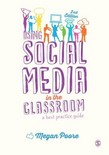
'A book for every teacher's bookshelf. This book gives a comprehensive overview of the tools and apps that can be used to help turn a mediocre teaching session into an outstanding one.' - Cheryl Hine, Leeds City College 'Megan Poore's updated text is needed more than ever, as social media becomes increasingly integrated in many aspects of education. I would recommend it to all practising teachers and trainee teachers, whatever their subject.' - Sue Howarth, University of Worcester This is an essential guide to using social media to enhance teaching and learning in schools. It combines practical information on using all forms of social media for educational purposes and provides indispensable advice on how to tackle issues arising from social media use in the classroom. Key topics include: using blogs, wikis, social media networks and podcasting, digital literacy and new modes of learning, digital participation, cyberbullying and understanding risk online. This second edition includes: * Reflective tasks in each chapter inviting you to critically consider important aspects of using social media in education. * Expanded coverage of game-based learning and mobile learning. * New examples tailored for use in primary and secondary schools. * A website including additional resources and handouts c. This is essential reading for anyone training to teach in schools, and experienced teachers seeking to improve their understanding of using social media for teaching in informed and appropriate ways.
`If there is a single question that presses upon the intellect of the current generation of social scientists, it is surely: "what do the great insights of social theory imply for the way we conduct research and write about the social world?". Until now there has been no single text to turn to that explores the epistemological complexities of ......
`If there is a single question that presses upon the intellect of the current generation of social scientists, it is surely: "what do the great insights of social theory imply for the way we conduct research and write about the social world?". Until now there has been no single text to turn to that explores the epistemological complexities of ......
Using Software in Qualitative Research is an essential introduction to the practice and principles of Computer Assisted Qualitative Data Analysis (CAQDAS). The book will help you to choose the most appropriate package for your needs and get the most out of the software once you are using it. This book considers a wide range of tasks and processes in the data management and analysis process, and shows how software can help you at each stage. In the new edition, the authors present three case studies with different forms of data (text, video and mixed data) and show how each step in the analysis process for each project could be supported by software. The new edition is accompanied by an extensive companion website with step-by-step instructions produced by the software developers themselves. Software programmes covered in second edition include the latest versions of: ATLAS.ti DEDOOSE HyperRESEARCH MAXQDA NVivo QDA Miner TRANSANA Ann Lewins and Christina Silver are leading experts in the field of CAQDAS and have trained thousands of students and researchers in using software. Reading this book is like having Ann and Christina at your shoulder as you analyse your data!
Using Software in Qualitative Research is an essential introduction to the practice and principles of Computer Assisted Qualitative Data Analysis (CAQDAS). The book will help you to choose the most appropriate package for your needs and get the most out of the software once you are using it. This book considers a wide range of tasks and processes in the data management and analysis process, and shows how software can help you at each stage. In the new edition, the authors present three case studies with different forms of data (text, video and mixed data) and show how each step in the analysis process for each project could be supported by software. The new edition is accompanied by an extensive companion website with step-by-step instructions produced by the software developers themselves. Software programmes covered in second edition include the latest versions of: ATLAS.ti DEDOOSE HyperRESEARCH MAXQDA NVivo QDA Miner TRANSANA Ann Lewins and Christina Silver are leading experts in the field of CAQDAS and have trained thousands of students and researchers in using software. Reading this book is like having Ann and Christina at your shoulder as you analyse your data!
Judith Milner and Jackie Bateman are both solution focused practitioners, trainers, consultants and writers. Previously a senior lecturer in social work, Judith now acts as an a therapist, consultant and Independent Expert to family courts in child protection, domestic violence and contested contact cases.
This is the perfect companion for students who are learning to use the SPSS software to interpret and manage data. The Eighth Edition uses version 29 of the software and incorporates results from the 2022 General Social Survey (GSS) as a dataset used in examples throughout the book. In response to user feedback, the author has expanded the ......
SPSS syntax is the command language used by SPSS to carry out all of its commands and functions. Jacqueline Collier's book is primarily aimed at people who have never used the syntax option in SPSS, or have just started to use it. This is a genuinely introductory text designed to show readers how to try using syntax themselves and to then support them through its use. It is ideal for those who are experienced in using SPSS through the usual button menu-driven graphical interface (GIF), but who are novices regarding syntax. This book supports the use of SPSS syntax in addition to the usual button and menu-driven graphical interface (GIF) using the two methods together, in a complementary way. The book is written in such a way as to enable you to pick and choose how much you rely on one method over the other, encouraging you to use them side-by-side, with a gradual increase in use of syntax as the knowledge, skills and confidence develop. The text outlines: - how to become familiar with the syntax commands through the use of the log; - how to create and manage the SPSS journal and syntax files; - and how to use them throughout the data entry, management and analysis process. Collier covers all aspects of data management from data entry through to data analysis and even includes managing the errors and the error messages created by SPSS. Syntax commands are presented with explanations of what each of the lines contributes and the value of syntax is clearly demonstrated through examples and explanation of their use. This book is of great benefit for all those carrying out quantitative research in the health and social sciences, who can benefit from SPSS syntax's capacity to save time, reduce errors, allow a data audit trail and, perhaps best of all, which will not actually require any initial knowledge of programming.
SPSS syntax is the command language used by SPSS to carry out all of its commands and functions. Jacqueline Collier's book is primarily aimed at people who have never used the syntax option in SPSS, or have just started to use it. This is a genuinely introductory text designed to show readers how to try using syntax themselves and to then support them through its use. It is ideal for those who are experienced in using SPSS through the usual button menu-driven graphical interface (GIF), but who are novices regarding syntax. This book supports the use of SPSS syntax in addition to the usual button and menu-driven graphical interface (GIF) using the two methods together, in a complementary way. The book is written in such a way as to enable you to pick and choose how much you rely on one method over the other, encouraging you to use them side-by-side, with a gradual increase in use of syntax as the knowledge, skills and confidence develop. The text outlines: - how to become familiar with the syntax commands through the use of the log; - how to create and manage the SPSS journal and syntax files; - and how to use them throughout the data entry, management and analysis process. Collier covers all aspects of data management from data entry through to data analysis and even includes managing the errors and the error messages created by SPSS. Syntax commands are presented with explanations of what each of the lines contributes and the value of syntax is clearly demonstrated through examples and explanation of their use. This book is of great benefit for all those carrying out quantitative research in the health and social sciences, who can benefit from SPSS syntax's capacity to save time, reduce errors, allow a data audit trail and, perhaps best of all, which will not actually require any initial knowledge of programming.