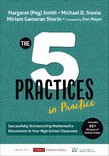
Successfully Orchestrating Mathematics Discussions in Your High School Classroom
Enhance your fluency in the five practices-anticipating, monitoring, selecting, sequencing, and connecting-to bring powerful discussions of mathematical concepts to life in your high school classroom.
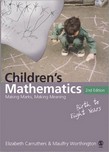
Visit the author's own website here! Children's Mathematics Network The Williams Report 2008: 'The role of mark-making in children's cognitive development is set out in the taxonomy (Carruthers and Worthington, 2006)...To secure effective pedagogy in early years mathematics, local authoritites, leaders, managers and head teachers should provide the following key elements: - A culture with a significant focus on mathematical mark-making - A learning environment that encourages children to choose to use their own mathematical graphics to support their mathematical thinking and processes' - The Williams Maths Review (Review of Mathematics Teaching in Early Years Settings and Primary Schools), DCSF 2008. 'At the very heart of the success of the book is the authors' ability to see mathematics through young children's eyes by listening to and reflecting on the constant efforts made by children to make sense of their world. This is a liberating book which proposes that the teaching of mathematics could and should be a highly creative and enjoyable proceess' - Branwen Llewelyn Jones, Early Years Consultant at PACE Ltd / TACTYC 'Ground breaking...To single out any one chapter would be unfair because there is something thought-provoking and inspirational throughout. If you want to expand your understanding upwards and outwards then get a copy soon' - Times Educational Supplement 'I first read Children's Mathematics, Making Marks, Making Meaning a couple of years ago and it had an immediate impact on my own thinking and teaching, and the work I do with trainee teachers. I'm sure you will find it compelling reading too. I think it has the potential to change, in a fundamental way, how we think about early mathematical development' - Lynne McClure, Editor, Math Co-ordiator's File, Mathematics Association 'In their exceptionally readable and informative book, Children's Mathematics, Making Marks, Making Meaning Carruthers and Worthington (2006) draw attention to one of the main goals of early years teaching, that is, to help children make links between the mathematics they have already encountered (and continue to engage with) at home and the more abstract mathematics of the school. These authors suggest that by encouraging children to represent mathematical ideas in their own ways and, crucially, by talking to the pupils about the marks they have made, we are given a "window" onto their thinking that may otherwise be inaccessible' - Liz Pumphrey, NRICH This book draws on the authors' many years of teaching children aged three to eight years and also on their extensive research with children in the home, nursery and school. The authors explain the development and range of young children's mathematical marks and visual representations, showing how children make mental connections between their own early marks and subsequent abstract mathematical symbolism, and go on to develop their own written methods. Combining theory and practice, this acclaimed book demonstrates how children's own mathematical graphics are highly creative and show deep levels of thinking. The authors show how this is the key to success in school mathematics and to higher levels of achievement. The authors are winners of TACTYC's (2003) Jenefer Joseph Award for the Creative Arts (3 - 8) - awarded for their innovative work with children on mathematical graphics.
The Strategies, Models, and Lessons to Teach the Big Ideas in Grades 3-5
Math is not rote-memorizable. Math is not random-guessable. Math is figure-out-able. Author Pam Harris argues that teaching real math-math that is free of distortions-will reach more students more effectively and result in deeper understanding and longer retention. This book is about teaching undistorted math using the kinds of mental reasoning ......
Grab your tool belt and hard hat! Students will learn perimeter while reading about a contractor's busy day. This text integrates math and literacy skills, and uses practical, real-world examples to help students explore math in a meaningful way.
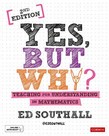
Getting the right answers in maths is only half the problem. Understanding why what you're doing works is the part that often stumps students and teachers alike. The essential guide for mathematics teachers and those training to teach, Yes, but why? answers all your questions, and sheds light on the hidden connections between everything in mathematics at school. This second edition includes: * A new 'Test yourself' feature in every chapter * More coverage of the four operations * Enhanced discussion of fractions and proportionality * Downloadable figures for use in the classroom
Number sense is a key indicator of future math success. Now there's a quick, reliable, and affordable way to screen early numerical competencies and identify students at risk for later math struggles. A pack of 25 record sheets.