"The biggest strength of the book is its pedagogic design, which will appeal to new entrants in the field but also leaves space for methodological debates... It is well suited for use on general courses but it also involves far more than an introduction and is full of theoretical insights for a more theoretically advanced audience." - Economic Geography Research Group In the last fifteen years economic geography has experienced a number of fundamental theoretical and methodological shifts. Politics and Practice in Economic Geography explains and interrogates these fundamental issues of research practice in the discipline. Concerned with examining the methodological challenges associated with that 'cultural turn', the text explains and discusses: qualitative and ethnographic methodologies the role and significance of quantitative and numerical methods the methodological implications of both post-structural and feminist theories the use of case-study approaches the methodological relation between the economic geography and neoclassical economics, economic sociology, and economic anthropology. Leading contributors examine substantive methodological issues in economic geography and make a distinctive contribution to economic-geographical debate and practice.
Alternative Perspectives in the Study of Global Trade and Development
As industrial globalization continues to surge, the impact of free trade on a global economy has remained one of the most debated topics in the sociopolitical arena. With the swelling popularity of the neo-liberal approach among economists and policy makers, it's crucial to keep the social, political, and environmental consequences of unrestricted trade at the forefront of the discussion. One of the most recent neo-liberal projects, the North American Free Trade Agreement (NAFTA), is an example of how the term free trade can bear distinct and contradictory meanings. Examining and clarifying the complex dimensions of NAFTA and its consequences sits at the core of this special issue of The Annals, which extends to offer in-depth analyses of specific countries and regions in Asia, Latin America, and Europe. Reflecting an interdisciplinary perspective from a group of distinguished scholars, the papers in this timely and thought-provoking issue are divided into three major sections: I. Political and Economic Dimensions of Free Trade Offering a bird's eye perspective on the global landscape, this first section provides readers with a solid framework to understand the concepts and applications of neo-liberal policies. II. NAFTA, Labor, and the Nation State Focusing on the relationship between labor and the state, these papers look at the causes and implications of economic globalization on economic inequality, civil society, and indigenous movements. III. Regionalization and Primary Goods Extraction What effects do neo-liberal projects have on agricultural, mining, and other primary resources? This final section reviews the environmental impact of a global economy. As the neo-liberalism approach continues to gain momentum, economists, sociologists, political scientists, and anthropologists must stay persistent in sustaining the debate over free trade tactics and their consequences. Providing an overall framework of the global landscape along with specific consequences of free trade, this issue of The Annals is a must-read for scholars and policy makers alike.
The authors, who form the Lancaster Regionalism Group, bring new research to bear on the ways in which places have been transformed through the changes taking place within them - shifts in the nature and quantity of paid and unpaid work, in social and political mobilization, in cultural and aesthetic experience and in the built environment. At the local level, the book draws on the authors' research on change in the city of Lancaster from its past as a place of manufacturing industry, through its current role as a centre of public services, and with increasing trends towards an alternative role in private services. At the general level the book relates the local detail to the broader social scientific analysis of social and economic change. How successfully do concepts of "restructuring" explain the relation between global and local change?.
The remarkably rich natural environment of Malaysia attracts the interest of both industry and the environmental community. Managing Natural Wealth analyzes major natural resource and environmental policy issues in the country during the 1970s and 1980s-a period of profound socioeconomic change, rapid depletion of natural resources, and the ......
How do we conceptualise the production and re-production of social life? What are the most appropriate ways to conceptualise capitalist economies and their geographies? Economic Geographies integrates ideas of structure, agency, and practice to provide: A detailed overview of recent key debates in economic geography: from political-economy and ......
This is a novel account of social change that supplants conventional understandings of `society' and presents a sociology that takes as its main unit of analysis flows through time and across space. Developing a comparative analysis of the UK and US, the new Germany and Japan, Lash and Urry show how restructuration after organized capitalism has its basis in increasingly reflexive social actors and organizations. The consequence is not only the much-vaunted `postmodern condition' but also a growth in reflexivity. In exploring this new reflexive world, the authors argue that today's economies are increasingly ones of signs - information, symbols, images, desire - and of space, where both signs and social subjects - refugees, financiers, tourists and fl[ci]aneurs - are mobile over ever greater distances at ever greater speeds.
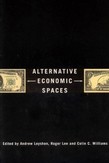
Alternative Economic Spaces presents a critical evaluation of alternatives to the global economic mainstream. It focuses on the emergence of alternative economic geographies within developed economies and analyses the emergence of alternative economic practices within industrialized countries. These include: - the creation of institutions like Local Exchange and Trading Systems, Credit Unions, and other Social Economy initiatives - the development of alternative practices from informal work to the invention of consumption sites that act as alternatives to the monoply of the 'big-box', multi-chain retail outlets Alternative Economic Spaces is a reconsideration of what is meant by the 'economic' in economic geography; its objective is to bring together some of the ways in which this is being undertaken. The volume shows how the 'economic' is being rethought in economic geography by detailing new economic geographies as they are emerging in practice.
Alternative Economic Spaces presents a critical evaluation of alternatives to the global economic mainstream. It focuses on the emergence of alternative economic geographies within developed economies and analyses the emergence of alternative economic practices within industrialized countries. These include: - the creation of institutions like Local Exchange and Trading Systems, Credit Unions, and other Social Economy initiatives - the development of alternative practices from informal work to the invention of consumption sites that act as alternatives to the monoply of the 'big-box', multi-chain retail outlets Alternative Economic Spaces is a reconsideration of what is meant by the 'economic' in economic geography; its objective is to bring together some of the ways in which this is being undertaken. The volume shows how the 'economic' is being rethought in economic geography by detailing new economic geographies as they are emerging in practice.