First published in 1970, the second edition of Basic Concepts of Probability and Statistics serves as an introductory textbook to these topics for readers with knowledge only of high school algebra and precalculus. Among the topics covered that readers may not expect in an elementary text are optimal design, survey sampling, and a statement and ......
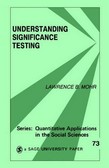
Significance testing is a core topic in statistics because it is a useful technique for testing a hypothesis. Mohr introduces the reader to the topic by first reviewing what is meant by sampling distributions and probability distributions, and then examining in-depth normal and t-tests of significance. In addition to these topics, Mohr explores the uses and misuses of significance testing.
Can taxometric procedures be used to distinguish types (species, latent classes, taxa) from continua (dimensions, latent traits, factors); and, if so, how? Aimed at demystifying this process, Waller and Meehl unpack Meehl's work on the MAXCOV-HITMAX procedure to reveal the underlying rationale of MAXCOV in simple terms and show how this technique ......
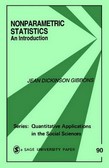
Through the use of actual research investigations that have appeared in recent social science journals, Gibbons shows the reader the specific methodology and logical rationale for many of the best-known and most frequently used nonparametric methods that are applicable to most small and large sample sizes. The methods are organized according to the type of sample structure that produced the data to be analyzed, and the inference types covered are limited to location tests, such as the sign test, the Mann-Whitney-Wilcoxon test, the Kruskal-Wallis test and Friedman's test. The formal introduction of each test is followed by a data example, calculated first by hand and then by computer.
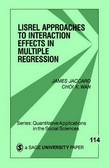
With detailed examples, this book demonstrates the use of the computer program LISREL and how it can be applied to the analysis of interactions in regression frameworks. The authors consider a wide range of applications including: qualitative moderator variables; longitudinal designs; and product term analysis. They describe different types of measurement error and then present a discussion of latent variable representations of measurement error which serves as the foundation for the analyses described in later chapters. Finally they offer a brief introduction to LISREL and show how it can be used to execute the analyses. Readers can use this book without any prior training in LISREL and will find it an excellent introduction to analytic methods that deal with the problem of measurement error in the analysis of interactions.
Emphasizing Simulation and Computer Intensive Methods
Integrating computers into mathematical statistics courses allows students to simulate experiments and visualize their results, handle larger data sets, analyze data more quickly, and compare the results of classical methods of data analysis with those using alternative techniques. This text presents a concise introduction to the concepts of ......
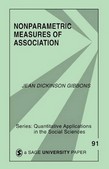
When analyzing data, how should the relationship between two or more sets of observations be described, that is, values of two or more variables, when the variables are ordinal and not bivariate normal? Aimed at helping the researcher select the most appropriate measure of association for two or more variables, the author clearly describes such techniques as Spearman's rho, Kendall's tau, Goodman and Kruskals' gamma and Somer's d and carefully explains the calculation procedures as well as the substantive meaning of each measure. In addition, each technique is illustrated by one or more examples from recent social or behavioural science studies. Finally, Gibbons provides information on the strengths and weaknesses of leading statistical packages for calculating these measures.
Bayesian Nonparametrics via Neural Networks is the first book to focus on neural networks in the context of nonparametric regression and classification, working within the Bayesian paradigm. Its goal is to demystify neural networks, putting them firmly in a statistical context rather than treating them as a black box. This approach is in contrast ......
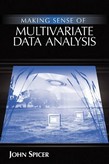
Making Sense of Multivariate Data Analysis is a short introduction to multivariate data analysis (MDA) for students and practitioners in the behavioral and social sciences. It provides a conceptual overview of the foundations of MDA and of a range of specific techniques including multiple regression, logistic regression, discriminant analysis, multivariate analysis of variance, factor analysis, and log-linear analysis. As a conceptual introduction, the book assumes no prior statistical knowledge, and contains very few symbols or equations. Its primary objective is to expose the conceptual unity of MDA techniques both in their foundations and in the common analytic strategies that lie at the heart of all of the techniques. Although introductory, the book encourages the reader to reflect critically on the general strengths and limitations of MDA techniques. Each chapter includes references for further reading accessible to the beginner. This is an ideal text for advanced undergraduate and graduate courses across the social sciences. Practitioners who need to refresh their knowledge of MDA will also find this an invaluable resource.