The economic crisis has created a host of problems for working people: collapsing wages, lost jobs, ruined pensions, and the anxiety that comes with not knowing what tomorrow willbring. Compounding all this is a lack of reliable information that speaks to the realities of workers. Commentators and pundits seem more confused than anyone, and ......
This groundbreaking volume of The ANNALS provides the first overview of class action laws and related mechanisms around the world. It features 30 "country reports" by leading scholars, describing the adoption, characteristics and consequences to date of class action and non-class group litigation procedures ranging across North and Latin America, Australia, Asia and Europe. What were once seen as singular disputes between individuals (or between an individual and a corporation) are now viewed increasingly as group struggles against multinational corporations and other global institutions. This escalating trend of class actions and group litigation in private civil court cases extends well beyond the interest of lawyers. The social, economic, and political ramifications of permitting class actions are potentially vast-not just in the United States, but increasingly throughout the world, as in less than a decade the number of countries that permit representative litigation by private actors has multiplied dramatically. The United States has led the way in these developments. Adopted by the U.S. federal judiciary in 1966, group litigation made it easier for individuals to come forward to claim remedies, including money damages, on behalf of large groups of similarly affected individuals. Class actions dramatically shift the balance of power between the "haves" and the "have-nots." Yet as this trend has grown in the United States. and has taken hold around the globe, little analysis has been done on the costs or outcomes of group litigation - and even less is known about litigants' and lawyers' choices to prosecute class actions. There is impassioned debate over the cost and benefits of class litigation in the United States. Does it impose costs on economic factors that are larger than any benefit it creates - thereby diminishing social welfare? By placing responsibility for social reform and public policy in the hands of appointed judges or lay jurors - rather than elected legislators - does it produce outcomes that are not supported by the majority of citizens? In December 2007, Stanford Law School and the Oxford Centre for Socio-Legal Studies organized an international conference that studied the global spread of class actions and group litigation procedures. Scholars, jurists, and practitioners from around the world gathered to discuss and debate the use of group litigation procedures and initiate a research project on the evolution of class actions and aggregate litigation worldwide. This volume of The ANNALS is one result of that conference. Students, scholars and policymakers will find this anthology of reports to be an essential overview, providing a solid understanding of the effects of class actions around the globe.
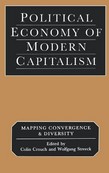
Neoliberalism and deregulation have come to dominate national and international political economy. This major book addresses this convergence and analyzes the implications for the future of capitalist diversity. It considers important questions such as: Is the preference for free markets a well-founded response to intensified global competition? ......
Why do so many advocates remain silent on key issues they care about and how does that silence contribute to narrowly defined policies? What can individuals and organizations do to amplify their privately expressed concerns for policy change? This title addresses these questions through the lens of state-level health care advocacy for the poor.
Alternative Perspectives in the Study of Global Trade and Development
As industrial globalization continues to surge, the impact of free trade on a global economy has remained one of the most debated topics in the sociopolitical arena. With the swelling popularity of the neo-liberal approach among economists and policy makers, it's crucial to keep the social, political, and environmental consequences of unrestricted trade at the forefront of the discussion. One of the most recent neo-liberal projects, the North American Free Trade Agreement (NAFTA), is an example of how the term free trade can bear distinct and contradictory meanings. Examining and clarifying the complex dimensions of NAFTA and its consequences sits at the core of this special issue of The Annals, which extends to offer in-depth analyses of specific countries and regions in Asia, Latin America, and Europe. Reflecting an interdisciplinary perspective from a group of distinguished scholars, the papers in this timely and thought-provoking issue are divided into three major sections: I. Political and Economic Dimensions of Free Trade Offering a bird's eye perspective on the global landscape, this first section provides readers with a solid framework to understand the concepts and applications of neo-liberal policies. II. NAFTA, Labor, and the Nation State Focusing on the relationship between labor and the state, these papers look at the causes and implications of economic globalization on economic inequality, civil society, and indigenous movements. III. Regionalization and Primary Goods Extraction What effects do neo-liberal projects have on agricultural, mining, and other primary resources? This final section reviews the environmental impact of a global economy. As the neo-liberalism approach continues to gain momentum, economists, sociologists, political scientists, and anthropologists must stay persistent in sustaining the debate over free trade tactics and their consequences. Providing an overall framework of the global landscape along with specific consequences of free trade, this issue of The Annals is a must-read for scholars and policy makers alike.
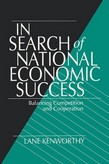
Using detailed case studies with statistical analysis In Search of Economic Success assesses comparatively the `market liberal' belief in free markets, limited government and the trade-off between economic efficiency and social justice. Kenworthy argues that the key to economic success lies in combining competition with cooperation. Among advanced industrialized nations, the countries achieving the best economic performance results over the past three decades have been the most committed to combining competition and cooperation. Those faring worst rely predominantly on atomistic, individualistic competition. In the end, the comparative record strongly supports a focus on cooperation-inducing institutions.
Neoliberalism and deregulation have come to dominate national and international political economy. This major book addresses this convergence and analyzes the implications for the future of capitalist diversity. It considers important questions such as: Is the preference for free markets a well-founded response to intensified global competition? ......
China and the Contradictions of "Market Socialism"
This study examines the tensions growing within "market socialism", then explores the class forces that produced it and the social dislocation that it is generating. It analyzes the growing tensions between China and the USA and their roots in China's push to lead in the world market.