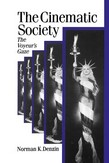
What influence does the cinema have on visual culture and social understanding? In what ways are we products of the cinematic gaze? This timely book, written by one of the leading commentators in the sociology of culture, highlights the extent to which the cinema has contributed to the rise of voyeurism throughout society. The cinema not only turns its audience into voyeurs, eagerly following the lives of its screen characters, but repeatedly casts its key players as onlookers, spying on other people's lives. The nature of the cinematic voyeur - the obsessive outsider, the ethnic or sexual Other - is examined in depth, as are its implications for contemporary society. Denzin analyses Hollywood's manipulations of gender, race and class, and, drawing on the work of Foucault argues that the cinematic gaze must be understood as part of the machinery of surveillance and power which regulates social behaviour in the late twentieth century. The effect of the cinema in the social construction of everyday life has rarely been explored with such penetration and clarity. Ranging over a rich and varied array of material from film and film literature, and encompassing a critical interrogation of traditional realist ethnographic and cinematic texts, The Cinematic Society will be essential reading for students of social theory, sociology of culture and film studies. 'Adopting as a central premise the notion that the constitution of subjectivity occurs through the gaze of the Other, and locating the voyeur as the anti-hero of cinematic society, Denzin enters into a brilliant analysis of multiple forms of the voyeur's gaze' Peter McLaren, University of California, Los Angeles
From the Superman of comic books to Hollywood's big-screen action stars, Americans have long enjoyed a love affair with the superhero. In this engaging volume John Shelton Lawrence and Robert Jewett explore the historical and spiritual roots of the superhero myth and its deleterious effect on Americas democratic vision. Arguing that the superhero ......
This book examines the complex and dynamic relationship between the popular press and popular culture. Martin Conboy rejects approaches to popular culture which restrict themselves to the contemporary, arguing for the importance of an historical perspective in understanding the contemporary relationship between the popular and the press. ......
This beautifully illustrated overview of the folk arts of New Mexico from the sixteenth century to the present covers both religious and secular arts including festivals, music, dance, and the visual arts.
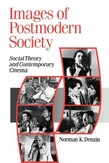
By using a series of studies of contemporary mainstream Hollywood movies - Blue Velvet, Wall Street, Crimes and Misdemeanors, When Harry Met Sally, Sex Lies and Videotape, Do the Right Thing - Norman Denzin explores the tension between ideas of the postmodern, and traditional ways of analyzing society. The discussion moves between two forms of text: social theory and cinematic representations of contemporary life. Denzin analyzes the ideas of society embedded in poststructuralism, postmodernism, feminism, cultural studies and Marxism through the ideas of key theorists like Baudrillard, Barthes, Habermas, Jameson, Bourdieu and Derrida. He relates these to the problematic of the postmodern self as exposed in cinema centering on the decisive performance of race, gender and class.
This work considers the visual languages, politics and poetics of personal appearance. Dandyism has been most closely associated with the 19th-century style of men such as Oscar Wilde. This book examines the wider influence of dandyism and considers its destablizing aesthetic effect.
This work considers the visual languages, politics and poetics of personal appearance. Dandyism has been most closely associated with the 19th-century style of men such as Oscar Wilde. This book examines the wider influence of dandyism and considers its destablizing aesthetic effect.
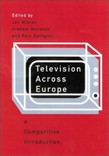
Combining institutional textual and audience analysis, this book introduces students to the factors which have shaped television's development in contemporary Europe, and invites them to assess the issues that are at stake in its future. Divided into three parts, the book moves from the European broadcasting environment, through current ......