For over a thousand years, Eastern Christendom had as its center the second capital of the Roman Empire - Constantinople, the "New Rome", or Byzantium. The geographical division between the Eastern and Western Churches was only one manifestation of deeper rifts, characterized by a long history of conflicts, suspicions, and misunderstandings. ......
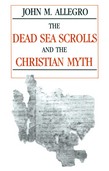
Was Jesus of Nazareth a real historical person or a fictional character in a religious legend? What do the Dead Sea Scrolls reveal about the origins of Christianity? Has there been a conspiracy to suppress information in the Scrolls that contradicts traditional church teaching? This book addresses these and many other questions.
The Library of Early Christianity will be a permanent enterprise that publishes one new volume approximately every other year. The Library will publish texts in the original ancient languages of both East and West - Greek, Latin, Arabic, Syriac, Coptic, Ethiopic, Armenian, and Georgian - accompanied by contemporary English translations printed on ......
St. Cyril, Patriarch of Alexandria for thirty-two years in the first half of the fifth century, was a great champion of the faith against heresy; he opposed Novatianism, Neoplatonism, and Judaism. His principal struggle, however, was with Nestorius, Patriarch of Constantinople. Cyril vehemently defended the application of the word Theotokos, which ......
This second and final volume of the letters of St. Cyril, Patriarch of Alexandria (412-444), takes up in medias res the great Christological controversy about the term Theotokos and the events which lead up to its resolution at the Council of Ephesus in 431. Defending the doctrines of the Trinity and the Person of Christ in the Alexandrian ......
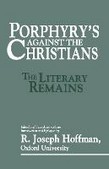
Not much has survived its condemnation by the imperial Church in 448, but here is a new edition of the fragments of Porphyry of Tyre's (ca. 232 - ca. 305) attack on the beliefs and doctrines of Christianity, the divinity of Christ, the integrity of the apostles, and the reality of the resurrection.
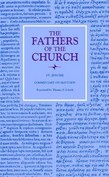
St. Jerome (347-420) has been considered the pre-eminent scriptural commentator among the Latin Church Fathers. His Commentary on Matthew, written in 398 and profoundly influential in the West, appears here for the first time in English translation. Jerome covers the entire text of Matthew's gospel by means of brief explanatory comments that ......
This volume offers a comprehensive portrait of St. Augustine (354-430) drawn from the breadth of his writings and from the long course of his career. One chapter is devoted to each of his masterpieces (Confessions, On the Trinity, and City of God) and one to each of his best-known controversies (against Manichees, Donatists, and Pelagians). It ......