A contribution to the use and understanding of multicriteria evaluation methods in public planning in general and by experts employed in the urban and regional field in particular.
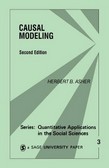
A substantially revised and updated edition of an earlier volume in the series. Asher presents a number of techniques of causal modelling, beginning with the work of Simon and Blalock, and moving on to recursive and non-recursive path estimation. Special attention is given to a number of problems in the causal analysis of data, with illustrations from studies in political socialization and voting behaviour.
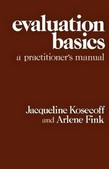
A step-by-step guide through the process of programme evaluation which takes into account all the evaluator's roles -- not just as researcher, but as negotiator, administrator and organizer, writer, and communicator. Kosekoff and Fink offer some of the techniques that have proven useful in their own professional evaluation practice. They show how to appraise a programme's merit, and provide information about its goals, expectations, outcomes, impact and costs.
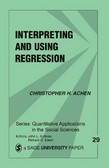
Interpreting and Using Regression sets out the actual procedures researchers employ, places them in the framework of statistical theory, and shows how good research takes account both of statistical theory and real world demands. Achen builds a working philosophy of regression that goes well beyond the abstract, unrealistic treatment given in previous texts.
The Community-Orientated Needs Assessment (CONA) model presented by the authors demonstrates that effective two-way communication between providers of human services and the community is necessary for effective and efficient social services. The CONA model uses data from demographic/statistical profiles, key informants, and random community members to define needed services, to develop programs, and to improve accountability. The authors both outline the logic behind the use of this model and sketch a step-by-step approach for developing the model for use in a variety of settings.
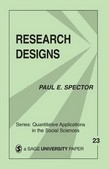
Research Designs is a clear, compact introduction to the principles of experimental and non-experimental design -- especially written for social scientists and their students. Spector covers major designs including: single group designs; pre-test/post-test designs; factorial designs, hierarchical designs; multivariate designs; the Solomon four group design; panel designs; and designs with concomitant variables. 'Bearing in mind the brevity (and hence cheapness) of the book, its coverage is extremely wide-ranging...As long as a basic grounding is achieved beforehand, attending to Spector's advice and comments should help budding researchers become aware of the issues and problems involved in practical research...the small outlay involved in buying the book will neither be regretted nor wasted.' -- Quality and Quantity, Vol 16, 1982