We are an independent publisher and registered charity (non-profit organisation) dedicated to making available the work of Rudolf Steiner in English translation. We care a great deal about the content of our books and have hundreds of titles available – as printed books, ebooks and in audio formats.
Rudolf Steiner (1861-1925) called his spiritual philosophy “anthroposophy”, meaning “wisdom of the human being”. As a highly developed seer, he based his work on direct knowledge and perception of spiritual dimensions. He initiated a modern and universal “science of spirit”, accessible to anyone willing to exercise clear and unprejudiced thinking.
From his spiritual investigations Steiner provided suggestions for the renewal of many activities, including education (both general and special), agriculture, medicine, economics, architecture, science, philosophy, religion and the arts. Today there are thousands of schools, clinics, farms and other organizations involved in practical work based on his principles.
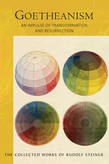
Contributions to a Methodical Schooling in Colour Experience
'What is postulated here is not the dogmatic laying down of a way of working. Rather the aim is to make evident one possible means of access to an experience of the colour world... and guide actual practice to Rudolf Steiner's sketch motifs - to their eminent educational power - for we recognize in them a path that can become of great significance ......
Over the course of the last decades, there has been an increasing demand by people for spiritual experience - whether it involves elemental beings, past incarnations or encounters with angels. But how should we distinguish between reality and illusion in such perceptions, particularly when efforts are often focused on instantaneous experience? Is ......
Where do we come from? The idea of human origins – the whole pattern of prehistory – has been through a revolution. The long-held Darwinian view purported to show how adopting an upright posture caused the gradual transition from animal to human. That theory has fallen apart spectacularly. Human orientation and equilibrium are now seen as a ......
Studies in Liturgy, Number and John's Gospel (1925-1982)
From its very beginning Christianity not only had the "message" but, in the sacrament, an experience of the "essence". Christianity lived for some time without the New Testament, which first had to be written. But it never lived without the Eucharist.' - Rudolf Frieling
Building on his existing works of contemporary Christian research, Living ......
Marie Steiner-von Sivers and the Development of the Arts at the Goetheanum - Reminiscences, Biography, Documentation -1902-1948
Focusing on Marie Steiner-von Sivers' distinctive collaboration with Rudolf Steiner, From the History of the Dornach Hill... offers an engaging, lively narrative of the early decades of the anthroposophical movement. Utilizing eye-witness accounts and primary sources, Angela Locher creates vivid images of the developing arts at the Goetheanum - in ......
Speaking just months after the end of the First World War, Rudolf Steiner urges his audience to awaken to the practical relevance of spiritual knowledge. Serious engagement with contemporary spiritual-scientific concepts can awaken healthy forces of the will, which in turn facilitate constructive action in the outer world. Conversely, ideas that ......
In the case of a solar eclipse, the evil that has spread over the earth can be carried out into the cosmos to wreak more havoc there, whereas in the case of a lunar eclipse, people who absolutely want to be possessed by evil thoughts can receive them from the cosmos.'
In the first full translation of this lecture course, Rudolf Steiner implores ......
Knowledge of the cosmic significance of Christ and his mission, once experienced intuitively, has faded over the centuries. As theologians and historians of the Church critically scrutinized the Gospel records, their focus shifted from a gnostic vision of Christ to the human figure of ‘the simple man’, Jesus of Nazareth. In these enlightening ......
There will be a resurrection - a resurrection that should not be imagined politically... but it will be a resurrection. Goetheanism still rests in the grave as far as external culture is concerned. But Goetheanism must rise again.' In the first winter following the Great War, Rudolf Steiner appealed to the spirit of Central Europe - which he ......