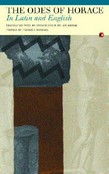
Horace (65-8 BC) is the most beguiling of the great Latin poets. He has left an ineradicable mark on Western literature: Dante placed him alongside Homer and Virgil, and his works have been translated and re-imagined since the Renaissance. Len Krisak, an acclaimed poet and translator, provides a close metrical translation of the four books of the Odes and the Centennial Hymn, the first for many years. He translates for the modern reader, combining linguistic precision with an ebullient sense of the possibilities of these inexhaustible works as poems in English. Printed alongside the Latin text, Krisak's translations provide a line-for-line sense of the Latin rhythms, while rendering them in a living English that captures both the wit, tenderness and the occasional irascibility of the great Roman poet. Supporting notes clarify allusions and historical and mythological names. Here Horace's world is made luminously accessible to eye and ear.
Quintus Horatius Flaccus, known in English as Horace, was born at Venusia, near the border of Apulia, in 65 B.C. His father, a former slave who had freed himself before the birth of his son, sent him to school in Rome. As a young man Horace went to Athens and studied philosophy at the famous schools. When the Civil War broke out he enlisted in the army of Brutus, served at Philippi, and came back to Rome not long after. Deprived of his property as a result of the proscriptions, he began life anew at the age of twenty-four as a clerk in a public office. Not long after, he attracted the attention of Mecenas, and soon became acquainted with Varius and Virgil, henceforth devoting himself to literary pursuits. HIs first work, the first book of Satires, was published in 35 B.C. About a year later, Mecenas presented him with the celebrated Sabine Farm, and Horace was at liberty to the end of his life to do as he liked. Before he died he was famous: the Emperor Augustus commissioned him to write the fourth book of Odes. He died eight years before the birth of Christ. Len Krisak's most recent books are the Carmina of Catullus (Carcanet Press), Ovid's Erotic Poems (University of Pennsylvania Press), the Eclogues of Virgil (U. of Penn. Press), Horace's Odes (Carcanet), and Rilke's New Poems, 1907-1908 (Boydell & Brewer), all translations. His own work includes Afterimage (Measure Press, University of Evansville), If Anything (Word Press), and Even as We Speak (University of Evansville Press), winner of the Richard Wilbur Poetry Prize. He is also the recipient of the Robert Penn Warren and Robert Frost Prizes in poetry, and with work in the PN, Hudson, Sewanee, Antioch, and Southwest Reviews, is a four-time champion on Jeopardy!
Carpe diem, and all that The Odes of Horace, translated by Len Krisak, is an excellent reworking of the Latin author's poetry, says Nicholas Lezard. I trust you are all among the readers who sent Harry Mount's book about Latin, Amo, Amas, Amat, and All That, to the top of the Amazon book charts last week (well, to number 14, but that's still pretty good). So now you all know Latin. Great! Now, which great Latin author are you going to read? I suggest Horace, for two reasons: first, because you quite simply have to know him. You cannot claim to care a fig for poetry unless you have at least a rough idea of what he was about; and his essence is in his Odes. (You will find that, like Shakespeare, they are full of quotes. "Carpe diem", "Nunc est bibendum", "Exegi monumentum aere perennius", and so on.) Second, to show you that Latin isn't actually a walk in the park. Horace's Latin is hard: packed, allusive, almost impenetrably elegant unless you know your stuff. One of Kipling's Stalky & Co stories is more than half taken up with a Latin class hacking its way through Book 3, Ode 5. If you have ever really had to study the language, it will send a chill through you. ("Your rendering of probrosis alone stamps you as lower than the beasts of the field," says the teacher.) The good news about this is that Horace gets translated with great frequency. Considering he's been dead for 2,000 years, it's remarkable that you never really have to wait too long for a new version to come along. He is to poetry what "Yesterday" is to the pop song: he's covered more than anyone else. And what with all the translations, versions and adaptations that have been going on, in English at least, since the mid-16th century (pace Frederic Raphael, who in his witty foreword claims the tradition begins with Dryden), Horace is almost as much a fixture in the native heritage as he is in the Roman. And this translation is, as far as I can see, very good indeed. Len Krisak has gone for rhyme - Horace didn't, but then rhythm was what counted in Latin poetry, and it can't be replicated in English to the same effect. Krisak actually does stick as well as any English speaker has to the metre. He has also made a great effort to keep to the same verse scheme as Horace, and that's hard, considering how packed the original is. (Example: "credite, posteri" has to become "believe me, times to come"; five English words having to do the work of two Latin ones; but Krisak keeps the syllabic count down to the original's.) At his best - and this, I think, is the way to go about it - Krisak can produce a poem that stands on its own. No knowledge of the source is necessary. Take his reworking of Book 1, Ode 15, which is, in a way, the Iliad in 36 lines. Krisak manages, somehow, to compress it all into 28, and gives it a force and punch reminiscent of Tony Harrison at his best: "They hadn't gotten far, that faithless pair, / When Nereus spotted Helen, Paris snug / Beside her. God, the two of them were smug! / But then the prophet spoke, and left them there, / Becalmed ..." Likewise Book 2, Ode 14: "Eheu fugaces, Postume, Postume". Krisak makes it look easy: "O Postumus, my friend, think of the years, / And how, my Postumus, they slip away, / Till old age brings the furrows ploughed by tears - / And death, which piety cannot delay." (He doesn't always manage this. In Book 1, Ode 11 - the "carpe diem" one - he finds himself obliged to double the length of the poem. But as this was standard practice for almost 500 years, we shouldn't complain.) As to the matter of the poetry itself, that's timeless. Horace knew it himself - there are plenty of little addresses to the contemporary reader ("credite, posteri"). The Horatian message is extremely beguiling, and unmistakeably his: relax, sit down, have a drink, money isn't everything, hot today, isn't it? Thank goodness for this nice fountain. And then, every so often, there's a snarl. He may have liked an easy life, but he wasn't soft. Krisak brings this all out superbly. It's a pity that in a book this beautifully produced there aren't enough notes, and no index of first lines. Never mind. Nunc est bibendum.