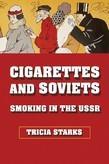
Winner of the Southern Conference on Slavic Studies Book Award Enriched by color reproductions of tobacco advertisements, packs, and anti-smoking propaganda, Cigarettes and Soviets provides a comprehensive study of the Soviet tobacco habit. Tricia Starks examines how the Soviets maintained the first mass smoking society in the world while simultaneously fighting it. The book is at once a study of Soviet tobacco deeply enmeshed in its social, political, and cultural context and an exploration of the global experience of the tobacco epidemic. Starks examines the Soviet antipathy to tobacco yet capitulation to market; the development of innovative cessation techniques and clinics and the late entry into global anti-tobacco work; the seeming lack of cultural stimuli alongside massive use; and the expansion of smoking without the conventional prompts of capitalist markets. She tells the story of Philip Morris's "Mission to Moscow" campaign for the Soviet market, the triumph of the quintessential capitalist product-the cigarette-in a communist system, and the successes and failures of the world's first national antismoking campaign. The interplay of male habits and health against largely female tobacco producers and medical professionals adds a gendered dimension. Smoking developed, continued, and grew in the Soviet Union without mass production, intensive advertising, seductive industrial design, or product ubiquity. The Soviets were early to condemn tobacco, and yet, by the end of the twentieth century Russians smoked more heavily than most most other nations in the world. Cigarettes and Soviets challenges interpretations of how tobacco use rose in the past and what leads to mass use today.
Tricia Starks is Director of the Humanities Center and Professor of History at the University of Arkansas. She is the author of Body Soviet and Smoking under the Tsars.
INTRODUCTION: The Revolutionary Soviet Smoker 1. ATTACKED: Commissar Semashko and Tobacco Prohibition 2. RESURRECTED: Nationalized Factories and Revitalized Industry 3. SOLD: Revolutionary Advertising and Communist Consumption 4. TREATED: Individual Will and Collective Therapy 5. UNFULFILLED: Commissar Mikoian and Stalinized Production 6. MOBILIZED: Frontline Provision and Factory Evacuations 7. RECOVERED: Women's Kingdoms and Manly Habits 8. PARTNERED: Space Cigarettes and Soviet Marlboros 9. PRESSURED: Demographic Crisis and Popular Discontent 10. OVERWHELMED: The Post-Soviet Smoker
Enlightening and thought-provoking. (Toward Freedom) Cigarettes and Soviets makes two important and original contributions to the existing public health literature: it recounts an episode of the history of tobacco different from the much more studied one in the West, and it is the liveliest history I know of the evolution of public health in the USSR. The illustrations are esthetically compelling, and Starks excels in describing their content, hidden meaning, and even taste and feel for the smoker. (American Journal of Public Health) Cigarettes and Soviets makes important contributions to recent work on the global history of tobacco use, along with adding to our understanding of socialist consumption and everyday life. Most delightfully, Starks's book demonstrates a keen understanding of Soviet visual culture in all its unex- pected and paradoxical dimensions, and her beautiful prose evokes the sights and smells of ordinary places in the USSR. (Russian Review) Tricia Starks tells the story of tobacco and smoking during the Soviet period. But perhaps it is more accurate to say that she tells part of the history of the Soviet Union through the prism of smoking (Moscow Times) a beautifully written and jargon free account. (New Books Network)