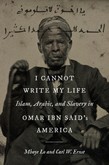
The extraordinary life and thought of Omar ibn Said, in his own words
Omar ibn Said (1770–1863) was a Muslim scholar from West Africa who spent more than fifty years enslaved in the North Carolina household of James Owen, brother of Governor John Owen. In 1831 Omar composed a brief autobiography, the only known narrative written in Arabic by an enslaved person in North America, and he became famous for his Arabic writings. His enslavers also provided him with an Arabic Bible and claimed Omar as a convert to Christianity, prompting wonder and speculation among amateur scholars of Islam, white slave owners, and missionaries. But these self-proclaimed experts were unable or unwilling to understand Omars writings, and his voice was suppressed for two centuries.
Mbaye Lo and Carl W. Ernst here weave fresh and accurate translations of Omars eighteen surviving writings, for the first time identifying his quotations from Islamic theological texts, correcting many distortions, and providing the fullest possible account of his life and significance. Placing Omar at the center of a broader network of the eras literary and religious thought, Lo and Ernst restore Omars voice, his sophisticated engagement with Islamic and Christian theologies, his Arabic skills, and his extraordinary efforts to express himself and exert agency despite his enslavement.
Mbaye Lo is associate professor of the practice of Asian and Middle Eastern studies and international comparative studies at Duke University.
Carl W. Ernst is William R. Kenan Jr. Distinguished Professor Emeritus at the University of North Carolina at Chapel Hill.
“Drawing on scrupulous close readings of Said’s work, Lo and Ernst make a worthy contribution to the scholarship on slavery in America and testify to the importance of evidence left behind by enslaved people themselves. This edifies.”—Publishers Weekly
“A crucial source for studying Islam in both West Africa and the United States, as well as for history, American studies, and Africana studies.”—Reading Religion
“I Cannot Write My Life provides an essential corrective to nearly two centuries of conjecture and fabrication about Omar ibn Said and his writings. . . . Lo and Ernst have done essential work, and all historians who intend to reference in any way Omar’s life and writings must read I Cannot Write My Life first lest they perpetuate the silencing of Omar’s remarkable voice.”—Journal of Southern History
“A puissant intervention in our understanding of American slave narratives, the history of Arabic writing in the United States, and the formation of a uniquely American discourse on Islam. . . . I Cannot Write My Life vivifies a literary history that is only now coming into focus.”—American Literary History
“Lo and Ernst have excelled in providing a critical reading, shrewd analysis of narratives, and rectifying the epistemic violence towards the subaltern. . . . [A] colossal work.”—Sociology of Islam
“I Cannot Write My Life stands as a valuable contribution to the exploration of the institution of slavery and the often unheard voices of those held captive. Scholars specializing in Arabic studies, historians with an interest in the transatlantic slave trade and slavery itself, and students across various historical disciplines can glean insights from the work of Lo and Ernst.”—H-Nationalism
“The book should garner a wide audience among scholars of the antebellum South, African and Islamic diasporas, and the Atlantic World.”—Journal of African American History
“I Cannot Write My Life is the most detailed and disciplined study of one of the most important figures of antebellum American and Muslim history. It is a must read for students of Islam in America and should be of interest to anyone engaged in Black transatlantic studies.”—Kambiz GhaneaBassiri, author of A History of Islam in America
“Lo and Ernst unshackle new insights and complex truths hidden inside the life and agency of Omar ibn Said. Inshallah, may his free spirit return to his two rivers.”—Jaki Shelton Green, North Carolina Poet Laureate
“This fresh and insightful look at the texts and contexts of Omar ibn Said debunks gross misinterpretations of Omar’s biography and thoughtfully juxtaposes his ‘unfreedom writings’ against the literary genre of formerly enslaved people’s freedom narratives.”—Rudolph T. Ware III, University of California, Santa Barbara