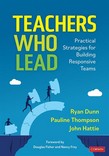
Support colleagues, inspire collaboration, and drive impactful school improvement.
Designed for instructional coaches, grade-level leaders, subject coordinators, and team leaders, Teachers Who Lead highlights proven strategies to enhance teaching practices, foster collaboration, and impact student learning on a broader scale.
Drawing from the latest research on teacher leadership, school improvement, and real-world experiences, this practical guide emphasizes the essential skills and mindsets required to bridge teaching excellence and schoolwide leadership efforts. Key features include
Whether you’re just beginning your leadership role or have been supporting colleagues for years, authors Ryan Dunn, Pauline Thompson, and John Allan Hattie provide actionable strategies to build confidence, promote student improvement, and make lasting contributions to your school.
Ryan Dunn, PhD, has twenty years’ experience as an educational leader, teacher, and researcher. Ryan has advised schools and systems in the United States, Canada, Singapore and Australia to develop innovative educational solutions. He has worked extensively in the United States, where he led large-scale research and professional learning initiatives in New York City and California. Ryan is a senior lecturer at the University of Melbourne, where he focuses on teacher professional learning, educational leadership, middle leadership, and implementation science.
Pauline Thompson (D.Ed.) is a senior lecturer in educational leadership at the Faculty of Education, The University of Melbourne. Pauline has vast experience working in schools as a teacher, middle leader, assistant principal and as an educational advisor. She is the course co-ordinator for the Master of Instructional Leadership, working with teachers and leaders to build their skills and knowledge to lead teaching and learning in their school. Her research interests include middle leadership, women in leadership, teacher career pathways, and teacher professional learning.
John Hattie, PhD, is an award-winning education researcher and best-selling author with nearly thirty years of experience examining what works best in student learning and achievement. His research, better known as Visible Learning, is a culmination of nearly thirty years synthesizing more than 2,100 meta-analyses comprising more than one hundred thousand studies involving over 300 million students around the world. He has presented and keynoted in over three hundred international conferences and has received numerous recognitions for his contributions to education. His notable publications include Visible Learning, Visible Learning for Teachers, Visible Learning and the Science of How We Learn; Visible Learning for Mathematics, Grades K-12; and 10 Mindframes for Visible Learning.
Foreword
Introduction
Chapter 1: Deciding about what to focus on and where to begin
Chapter 2: Narrowing the Focus, Designing Solutions and Providing Specific Models of Practice
Chapter 3: Leading the Development and Implementation of Shared Curriculum Resources
Chapter 4: Cultivating a collaborative team
Chapter 5: Taking the next step
This book is important for teachers serving as instructional leaders and the senior leaders recruiting and supporting them. It offers practical strategies and ideas, rooted in theory and practice to those leading in the space between the classroom and the main office. Punctuating the ideas it presents, are compelling stories from the field that provide engaging insights on challenges this level of leadership faces. It is a powerful resource for those seeking to grow their leadership impact over the short and long term. Whether you’re refining your practice or fostering leadership in others, this book is a valuable tool for navigating and excelling in the critical role of middle leader. -Wayne Davies
Here′s a book that so many teachers are looking for: one that helps them help others to extend their skills as teachers. Readable, incisive and immensely helpful, the prospect of leading and teaching feels possible... and enjoyable. -Mick Waters
Unfortunately, those chosen for the role of teacher leader do not always get the proper professional learning to be successful. Dunn, Thompson, and Hattie are providing the catalyst to change that dynamic in Teachers Who Lead. Make no mistake, this book is not just for anyone under the teacher leadership umbrella, it’s for every leader who wants to have a deep impact on students. -Peter DeWitt
This book is an indispensable guide for teachers navigating the complexities of leadership. With a sharp focus on practical strategies for building and sustaining high-performing collaborative teams, it bridges the gap between theory and actionable steps, offering rigor, research, case studies, and tools for reflection. Each chapter is thoughtfully crafted to inspire curiosity and provide clarity, addressing the unique challenges of teacher leadership while celebrating their agency and impact. A must-read for educators and those supporting them, this book equips readers to lead with purpose, strategy, and collaborative expertise. -Barbara Watterston
Teachers Who Lead expertly unpacks the complexity of leadership roles in schools, providing a comprehensive guide to navigating this transition so that leaders can contribute towards aligned school improvement. -Michael Chiles
Teachers Who Lead is an essential resource for instructional coaches, team leaders, and grade level leaders who seek to guide colleagues whilst improve school wide outcomes. The authors present a practical, research informed framework that balances evidence with real-world examples and offers clear strategies that leaders can implement. The book supports teachers’ expertise by drawing on evidence-based practices and professional learning. It shows how leaders can help colleagues strengthen their approach to teaching and build self-confidence in their practice. Collaboration is a key emphasis promoting trust, shared responsibility and collective improvement across teaching teams.
Importantly, the book keeps student learning at the forefront of leadership with every strategy aiming to translate teacher growth into better student outcomes. Whether it be providing feedback, facilitating dialogue or leading improvement initiatives through PLCs, students’ development is at the forefront.
I like the balance of practicality and research. The combination of actionable strategies, case studies and educational evidence makes it both accessible and powerful. For teachers stepping into leadership roles, Teachers Who Lead is an invaluable guide to building collaboration, strengthening expertise and making a measurable difference in student learning. - Deborah Langford, Acting Learning Leader, Tecoma Primary School, Victoria
Dunn, Thompson, and Hattie have created a resource offering practical strategies for educational leaders seeking to positively influence culture, build capacity, and strengthen systems. Written by professionals still connected to classrooms, the text is concise and respectful of educators’ time. Each strategy is illustrated with examples from a variety of year levels, subjects, and contexts, making the ideas accessible and adaptable.
The book incorporates advances in cognitive science and is supported with evidence of recent and relevant effectiveness as shared by practicing educators. The strategies may affirm and extend what many educators already do well, while also offering fresh perspectives and tools that can be readily applied. Importantly, the approaches allow for flexibility and autonomy to apply them individually or embed them within broader faculty and whole-school goals.
This book encourages professional dialogue and contributes to the growing body of evidence-based, practical resources that support teachers and leaders in refining their practice. - Andrew Hislop, Head of Science, QLD