Contact us on (02) 8445 2300
For all customer service and order enquiries

Woodslane Online Catalogues

9780826355850 Academic Inspection Copy

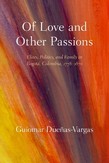
Of Love and Other Passions

Elites, Politics, and Family in Bogota, Colombia, 1778-1870
Description
Author
Biography
Reviews
Google
Preview
In Of Love and Other Passions Guiomar Duenas-Vargas delves into the world of emotions among the bourgeois elite in Bogota from the end of the colonial period to 1870. While most studies of the period focus solely on the country's political activity, Duenas-Vargas shows how Colombia's social, cultural, and political changes transformed the meaning of love, which contributed to the evolution of new models of femininity and masculinity. By examining sources such as personal letters and diaries, Duenas-Vargas presents the emotional profiles of families and couples, demonstrating how their conduct challenged the established order. As lovers insisted on choosing their own mates rather than marrying spouses selected by their parents, they undermined the patriarchal structure of Colombian society. Such decisions unveil the many functions women assumed in both public and private life and how they participated in the invention of a nation.
Guiomar Duenas-Vargas is a professor of history at the University of Memphis, USA. Her earlier books, like the Spanish edition of this one, were published in Colombia, USA.
a oe[This book] offers a new approach to the history of Colombia, one that highlights the importance of affect and subjectivity to understanding not only marriage and gender but also Colombian state and nation formation. Historians have been slow to evaluate the impact of broad movements like romanticism and modernism, leaving these to their colleagues in literature. This book shows how these ways of framing onea (TM)s place in the world might be central not only to the private sphere but also to broader changes in politics and the nation.a ?a "William French, coeditor of Gender, Sexuality, and Power in Latin America since Independence "Duenas-Vargas makes good use of letters (and diaries) to create a rich tapestry of the lives and loves of elite families. . . . [She] makes fascinating connections between internal, personal emotions and political culture." --Latin American Research Review
Google Preview content